Some of the links in this article are "affiliate links", a link with a special tracking code. This means if you click on an affiliate link and purchase the item, we will receive an affiliate commission.
The price of the item is the same whether it is an affiliate link or not. Regardless, we only recommend products or services we believe will add value to our readers.
By using the affiliate links, you are helping support our Website, and we genuinely appreciate your support.

# The simple breathing technique that calms my anxiety
You know that heavy, tight feeling in your chest right before a big meeting? Or the way your mind starts racing at 2 AM when you’re trying to fall asleep?
I’ve been there. A lot.
Last Tuesday, I was standing in line at a coffee shop on South Congress. The barista called out a name that sounded like mine but wasn’t. I froze. My heart did this weird little flip—*thump-thump-silence*—and suddenly I couldn’t breathe. It wasn’t a panic attack, not really. But it was close. It was that low-level, buzzing anxiety that hits when you feel like you’re being watched or evaluated.
I did what most of us do: I reached for my phone. Scrolled Instagram. Looked at emails. Made it worse.
Then I remembered a trick my best friend, Dr. Sarah, told me about. It’s not a supplement. It’s not a meditation app subscription. It’s the **simple breathing technique that calms my anxiety** when everything else feels like noise.
Here’s how it works. And more importantly, why it actually works for people who hate meditating.
## The Dilemma: Why “Just Breathe” Usually Fails
Let’s be honest. When someone tells you to “just breathe,” you usually want to scream. Because when you’re anxious, breathing isn’t “just” anything. It’s shallow. It’s up in your chest. It’s rapid.
Most of us breathe like we’re running from a bear, even when we’re just sitting in traffic.
I tried to start meditating three years ago. I bought the cushions. I downloaded the app. I sat for ten minutes. All I did was think about my to-do list and wonder if I left the stove on. I quit after four days.
But this technique? It’s different. It doesn’t require you to “clear your mind.” It requires you to do something mechanical. And that mechanical part is the key.
## The Verdict: Box Breathing (The Navy SEAL Method)
The specific method I use is called Box Breathing, or Square Breathing. It’s been used by Navy SEALs to stay calm under fire. If it works for soldiers in combat zones, it’s definitely going to work for your Tuesday morning stand-up meeting.
Here is the **simple breathing technique that calms my anxiety**:
1. **Inhale** through your nose for a count of 4.
2. **Hold** your breath for a count of 4.
3. **Exhale** through your mouth for a count of 4.
4. **Hold** your lungs empty for a count of 4.
That’s one box. You do this cycle four or five times.
It sounds too simple to be true. Right? I thought so too. Or at least, that’s what I thought until I tried it in that grocery aisle last week when I couldn’t find my car keys.
## Option A: The “Deep Belly” Breath
Before I found box breathing, I was obsessed with diaphragmatic breathing. You know the one—hand on your stomach, make it rise like a balloon.
It’s good. It’s very good. But here’s the problem: it takes practice. When my anxiety spikes, my body wants to do the opposite. It wants to tighten. Trying to force a deep belly breath can feel like wrestling an octopus.
I’d spend half my time worrying about whether I was doing it right.
## Option B: The “Exhale Focus” Breath
Some yogis say the secret is the exhale. Make it longer than the inhale. Inhale for 4, exhale for 8. This activates the parasympathetic nervous system (the “rest and digest” mode).
This works great for sleep. But for acute anxiety? It can sometimes make me feel lightheaded. I’d hold my breath too long waiting for the exhale to finish, and then I’d feel dizzy.
## Why Box Breathing Wins for Me
Box breathing is balanced. It’s symmetrical. It gives your brain a rhythm to lock onto.
When I’m anxious, my thoughts are chaotic. *Did I send that email? Is my skin breaking out? Why is that car honking?*
The count—1, 2, 3, 4—gives your prefrontal cortex (the logical part of your brain) a tiny job to do. It’s enough to distract you from the emotional chaos, but not enough to tire you out.
### The Physiology: What’s Actually Happening?
Here’s the science bit. I promise it’s not boring.
Your vagus nerve is the highway between your brain and your body. When you breathe slowly and evenly, you stimulate that nerve. It sends a signal to your brainstem saying, “Hey, we’re not being chased by a tiger. We’re safe.”
A study published in *Frontiers in Psychology* found that slow, rhythmic breathing can significantly reduce heart rate and blood pressure. Specifically, breathing at a rate of 6 breaths per minute (which is roughly 5 seconds in, 5 seconds out, or 4/4/4/4) maximizes heart rate variability.
Higher heart rate variability isn’t just a biohack trend. It’s a marker of resilience. It means your body can adapt to stress quickly.
[Check out our guide on how to improve heart rate variability for better overall health](/category/heart-health/)
## How to Actually Do It (Without Feeling Silly)
You don’t need to sit in lotus position. You don’t need incense. You can do this at your desk, in your car, or in the shower.
Here’s my step-by-step breakdown:
**Step 1: Get Comfortable (But Not Too Comfortable)**
If you’re lying down, you might fall asleep. If you’re standing, you might slump. Sit upright. Shoulders down. Unclench your jaw. Seriously, check your jaw. It’s probably tight.
**Step 2: The Inhale (4 Seconds)**
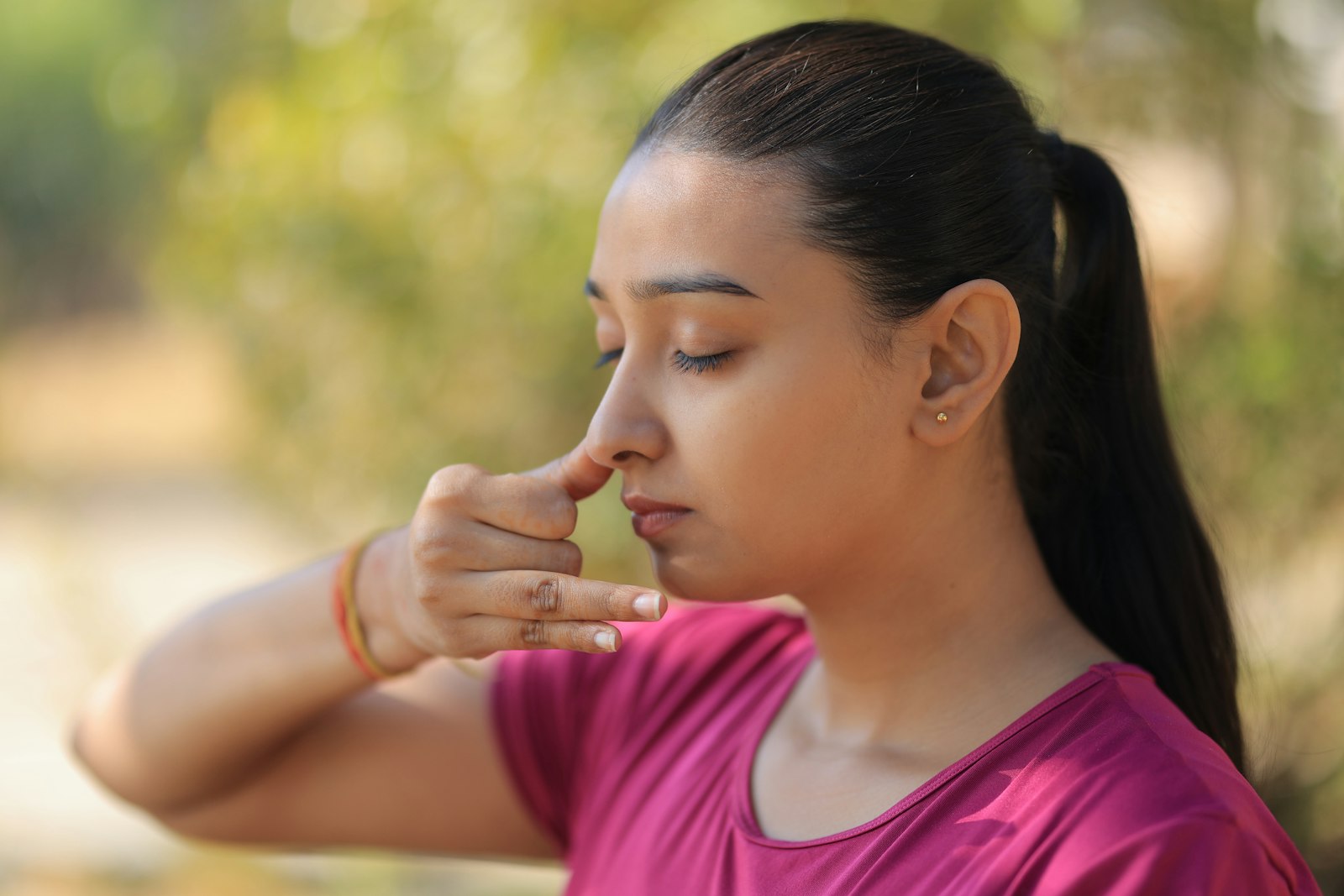
Breathe in through your nose. Not a sniff. A steady, controlled flow. Imagine you’re smelling a really good flower. Don’t force it. Just let it in.
**Step 3: The Hold (4 Seconds)**
This is the tricky part. Don’t puff out your cheeks. Just… pause. It feels like you need more air here. That’s normal. Trust the process.
**Step 4: The Exhale (4 Seconds)**
Breathe out through your mouth. Make a soft “whoosh” sound if it helps. Imagine you’re fogging up a mirror and then wiping it clean. Let it all go.
**Step 5: The Empty Hold (4 Seconds)**
Hold your lungs empty. Feel that tiny space before your body tells you to breathe again. That’s the reset button.
Do this four times.
Or at least, that’s what I thought until I realized I was rushing the counts. My first week, I was counting like this: *one-one-thousand, two-one-thousand…* It was too fast.
I slowed down. It took longer than I thought. And that slowness is the medicine.
## When to Use This Technique
I use this **simple breathing technique that calms my anxiety** in three specific scenarios.
**1. The Pre-Meeting Jitters**
Ten minutes before a call, I do five boxes. It lowers my resting heart rate so I don’t sound shaky on the audio.
**2. The Traffic Rage**
Stuck on I-35? Do five boxes. It stops the “road rage” from spiking your cortisol.
**3. The 3 AM Wake-Up**
When my brain starts replaying every awkward thing I’ve said since 2014, I do five boxes. It grounds me in the present moment.
If you want to dive deeper into managing stress, [read our article on natural ways to lower cortisol levels](/category/stress-management/).
## The “Failure” Moment
I’ll be honest. I messed this up for the first two weeks.
I did it *after* I was already panicked. I waited until my heart was pounding, my palms were sweaty, and I couldn’t think straight. Then I tried to breathe.
It didn’t work perfectly. I got frustrated. I thought, “This is useless.”
Then I changed my strategy. I started doing it *proactively*. When I felt a *hint* of stress. When I noticed my shoulders creeping up toward my ears.
That’s when it clicked.
It’s not a cure-all for every emotion. It’s a regulator. It’s like a circuit breaker. You flip it before the fuse blows.
## Why Consistency Beats Perfection
You don’t need to do this for an hour. You don’t need to be a monk.
Just four cycles. That’s 64 seconds.
I know, right? Less than time it takes to boil an egg.
But here’s the kicker: you have to do it every day, even when you’re not anxious. It trains your body to respond to the rhythm automatically. It builds a muscle memory.
Think of it like flossing. You don’t floss only when you have a cavity. You floss every day so you don’t *get* the cavity.
[Learn more about building healthy daily habits that stick](/category/habits/)
## The Bottom Line
If you’re looking for a quick fix, this isn’t it. If you’re looking for a tool to add to your toolkit, it’s gold.
The **simple breathing technique that calms my anxiety** isn’t magic. It’s biology. It’s your body’s built-in emergency brake.
So next time you feel that tightness in your chest, don’t reach for your phone. Reach for your breath.
Count to four.
And breathe.
## FAQ: Your Quick Questions Answered
**Q: Can I do this if I have asthma?**
A: Yes! But if you feel tight, drop the “hold” phases. Just do the inhale and exhale for 4 seconds each. It still works.
**Q: What if I feel dizzy?**
A: You’re probably hyperventilating. Slow down. Open your eyes. Drink some water. You’re doing it right, just too fast.
**Q: Does it work for public speaking anxiety?**
A: Absolutely. I do it in the bathroom right before I walk on stage. It’s my secret weapon.
**Q: How long until I see results?**
A: Immediate. But for long-term resilience, give it 30 days.
**Q: Can I do this while driving?**
A: Yes, but don’t close your eyes for the holds. Keep them open.
## A Note from Xiao Ai
I’m not a doctor. I’m just a girl from Austin who drinks too much coffee and reads a lot of science papers so you don’t have to.
Try this technique. Seriously. Give it three days. Let me know in the comments if it helped. Or if it didn’t, tell me what went wrong. We figure it out together.
Stay calm, friends. You’ve got this. 💛